Communication7 min read
One Sentence, Two Dictionaries
Why conversation goes flat with someone from a different background — and a counterintuitive result from 25 experiments: deliberately putting yourself in someone's shoes doesn't help you read them. It makes you more confident and less accurate.
You know the moment. You understood every word and still have no idea what the person meant. They said let’s see how it goes — a no, or a maybe? They agreed very politely, and only later did you realise it was a refusal.
This happens most obviously across languages. It happens well within them too, between people raised two provinces apart.
The difference is real, and it isn’t national character
In 2014 Thomas Talhelm’s team published a study in Science on north–south differences inside China. The hypothesis came from agricultural history: rice and wheat are two ways of organising a society. Paddy rice takes roughly twice the labour and depends on shared irrigation, coordinated across a whole village. Wheat is rain-fed; one household manages alone.
Across 1,162 Han participants, rice regions came out more interdependent and holistic, wheat regions more individualistic and analytic — the East/West contrast, reproduced inside one country. The elegant part: they compared neighbouring counties along the rice–wheat border, ruling out climate and latitude.
The strongest evidence came in 2024, in Nature Communications: China once quasi-randomly assigned people to two adjacent state farms, one rice and one wheat. Comparing 234 farmers, the difference appeared anyway — and can apparently form within one generation.
A history of farming rice makes cultures more interdependent.
种植水稻的历史,让文化变得更相互依赖。
Three theories, and they don’t agree
Stopping there would leave you with something tidy and dishonest. Rice theory has taken heavy fire. Economists who redid the analysis (Ruan, Xie & Zhang, 2015) found most original findings no longer held once sample bias and misspecification were corrected. Another noted the study folded corn and soybean into the wheat region — the north grows no less corn than wheat.
Then a 2021 study using 1,907 counties drew a different map entirely — four regions, with the Yangtze basin leaning individualist. The Yangtze basin is core rice country; a north–south split can’t produce that. A third, climato-economic theory agrees with neither.
What survives is sturdier than any one theory. The differences are real. They were shaped by material conditions, not temperament — no explanation on offer says “they’re just like that.” And they are modest group-level tendencies: none of it can predict the person in front of you.
So the charts aren’t dictionaries
That last point rings an alarm well beyond rice.
You’ve met high-context versus low-context — meaning carried by situation versus by words. Edward Hall proposed it in 1976 (the same anthropologist who measured interpersonal distance). A 2008 meta-analysis of 224 articles found it the field’s most-cited framework — and found most propositions derived from it barely tested, with those tested most often largely failing. A 2011 review traced the famous country classification to its origin: not grounded in traceable data. Hofstede’s dimensions carry a parallel problem, the ecological fallacy: national scores are individual responses aggregated upward, and what holds between countries needn’t hold between people.
Use the charts as a prompt that a difference might exist. Not as a lookup for what someone thinks.
The real mechanism: your own codebook
Intercultural communication usually fails not because you lack cultural knowledge, but because you run the other person’s signal through your own decoder.
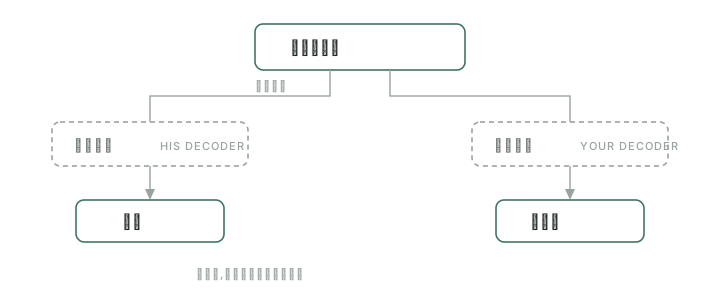
Where relationships are long and experience shared, meaning can live in the context. Where people are mobile and backgrounds mixed, it has to live in the words. Both are sensible adaptations. The trouble: you’re reading the words while they’re loading the context.
Misunderstanding within one culture is already the default. A five-experiment study (Kruger, Epley et al., 2005) found people systematically overestimate how well they’re understood over email — not from bad writing, from egocentrism: you hear your own sentence in the tone you intended, and the reader has no audio track.
Contact across cultures doesn’t create the crack. It widens one already there.
Don’t take their perspective — ask
In 2018, Eyal, Steffel and Epley published 25 experiments in JPSP, spanning expression-reading, lie detection and predicting a spouse’s preferences.
Told to take the other person’s perspective, participants showed no consistent gain in accuracy — overall it fell. Their confidence rose.
The mechanism is clean: perspective-taking reduces egocentric bias but doesn’t replace what it removes. You’ve pulled the anchor without supplying new coordinates. What you imagine is if I were them, not them.
What works is perspective-getting — asking, then listening. A meta-analysis of cultural intelligence (77 studies, 18,399 participants) agrees: of its four components, cultural knowledge is the weakest predictor and motivation the strongest.
Three things to do with that:
- Treat “why are they being so strange” as a signal, not a verdict — it usually means the codebooks differ: I may be using the wrong dictionary.
- Separate politeness formulas from positions. We should get dinner sometime is a real plan in some contexts and a synonym for goodbye in others.
- Ask concretely. “Are you upset?” demands a verdict. “When I said that, how did it land?” only asks for a description.
Coda
Everything that holds up points one way: the differences are real, and the ready-made answers about them are not.
Rice theory drew fire, high/low context lacks validation, Hofstede has the ecological fallacy, perspective-taking backfires. They fail identically — each tries to answer, with a general rule, what this particular person is thinking.
That question has one dependable source. Which is what this site is named for: say your piece, and don’t script the reply for them.
Don't rehearse the echo. Wait for the real one.
别预演回声。等真的那一声。
Sources
- Talhelm et al., Large-Scale Psychological Differences Within China Explained by Rice Versus Wheat Agriculture, Science, 2014; Moving chairs in Starbucks, Science Advances, 2018; Talhelm & Dong, People quasi-randomly assigned to farm rice are more collectivistic, Nature Communications, 2024
- Critiques: Ruan, Xie & Zhang, Does rice farming shape individualism and innovation?, Food Policy, 2015; Hu & Yuan and Roberts, Frontiers in Psychology, 2015
- Gong et al., The Lineage Theory of the Regional Variation of Individualism/Collectivism in China, Frontiers in Psychology, 2021
- Cardon, A Critique of Hall’s Contexting Model, JBTC, 2008 (DOI: 10.1177/1050651908320361); Kittler et al., IJCCM, 2011 (DOI: 10.1177/1470595811398797); High- and low-context cultures, EBSCO
- Hofstede’s 6D model; Brewer & Venaik, The Ecological Fallacy in National Culture Research, Organization Studies, 2014 (DOI: 10.1177/0170840613517602)
- Eyal, Steffel & Epley, Perspective Mistaking, JPSP, 2018; the authors’ own summary in HBR
- Kruger, Epley et al., Egocentrism over e-mail, JPSP, 2005; Gilovich, Savitsky & Medvec, The illusion of transparency, JPSP, 1998
- Tripathi et al., Cultural intelligence and cross-cultural adjustment: a meta-analysis, Journal of Global Mobility, 2024